Core Logic Mechanics
At its heart, Corridor Conundrum: Key Quest is about spatial reasoning and sequential planning. Each level presents a simple objective: locate the hidden key, then navigate to the level exit. The challenge comes from moving obstacles that patrol the corridors. These obstacles follow fixed, repeating patterns, turning each level into a small logic puzzle. Players must observe these patterns, identify safe windows, and chart a path that avoids contact. The game rewards careful observation over quick reactions, making it a pure test of mental planning.
Level Design & Progression
The game introduces new layouts gradually, starting with simple rooms and progressing to more complex configurations. Early levels may have a single obstacle and a straightforward path, while later stages weave multiple moving elements into tighter spaces. This gradual increase in complexity helps players build confidence and develop pattern recognition skills. Each layout feels distinct, with corridors and rooms arranged to create unique routing challenges. The progression system encourages players to think ahead rather than rely on trial and error.
Visual Style & Atmosphere
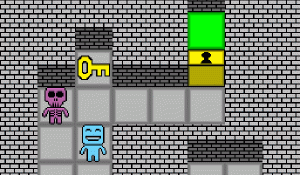
The game uses bright, cheerful colors and friendly character designs. The dungeon theme is lighthearted, with no dark or threatening imagery. Obstacles are stylized as playful skeletons that move in a bouncy, non-threatening manner. The overall visual tone is welcoming and suitable for younger players. Backgrounds and tiles are clean and uncluttered, making it easy to focus on the puzzle elements. The interface is simple, with clear indicators for the key location and exit point.
Accessibility & Controls
Controls are straightforward, using standard keyboard inputs to move the character in four directions. There are no complex button combinations or timing-sensitive actions. This simplicity makes the game accessible to players of all ages and skill levels. The game also includes a gentle learning curve, with early levels serving as a tutorial for basic movement and obstacle observation. Players who make a mistake simply restart the level, encouraging repeated attempts without frustration. The focus remains on thoughtful movement rather than speed or dexterity.
Strategic Thinking & Patience
Success in Corridor Conundrum: Key Quest depends on two main skills: pattern recognition and patience. Rushing through a level often leads to contact with an obstacle. Instead, players are encouraged to pause at the start of each level to watch the obstacle patterns. Planning a route that avoids all moving elements requires careful timing. The game teaches that a slow, deliberate approach is more effective than a fast, careless one. This makes it an excellent tool for developing patience and strategic thinking in a relaxed, non-competitive environment.